
Every day, millions of people browse the web, watch videos, search for information, and increasingly interact with generative AI tools such as ChatGPT, Gemini, and Claude. While these technologies have become essential parts of our personal and professional lives, their environmental impact often remains invisible.
Most users are aware that activities such as driving a car or heating a home consume energy and generate emissions. Far fewer realize that digital interactions also have a carbon footprint. The rapid adoption of generative AI is making this issue even more relevant, as AI systems require significant computational resources for every interaction.
The Challenge of Invisible Emissions
One of the main barriers to sustainable digital behavior is the lack of awareness. Unlike physical energy consumption, digital emissions are hidden behind screens, data centers, and network infrastructures.
As AI-powered services become integrated into search engines, office software, and everyday workflows, users rarely receive any indication of the environmental cost associated with their actions. Without visibility, informed choices become difficult. This raises an important question:
Can we help users understand the environmental impact of their digital activities and encourage more sustainable practices?
A Three-Step Approach to Digital Sustainability
Our research proposes a simple framework for promoting environmental awareness in digital interactions:
- Environmental Impact Monitoring and Measurement – tracking the energy consumption and carbon emissions generated by online activities.
- Interpretation-Driven Awareness Delivery – translating technical metrics into understandable and meaningful information.
- Awareness-Driven User Empowerment – helping users make informed decisions that can reduce their environmental footprint.
The goal is not to discourage the use of digital technologies, but rather to make their environmental impact visible and actionable.
Introducing Carbon Tracker
To put this vision into practice, we developed Carbon Tracker, a browser extension that estimates the carbon footprint generated by tracking:
- Traditional web browsing
- Web searches
- Interactions with ChatGPT
The extension provides real-time feedback directly within the user’s browsing experience.
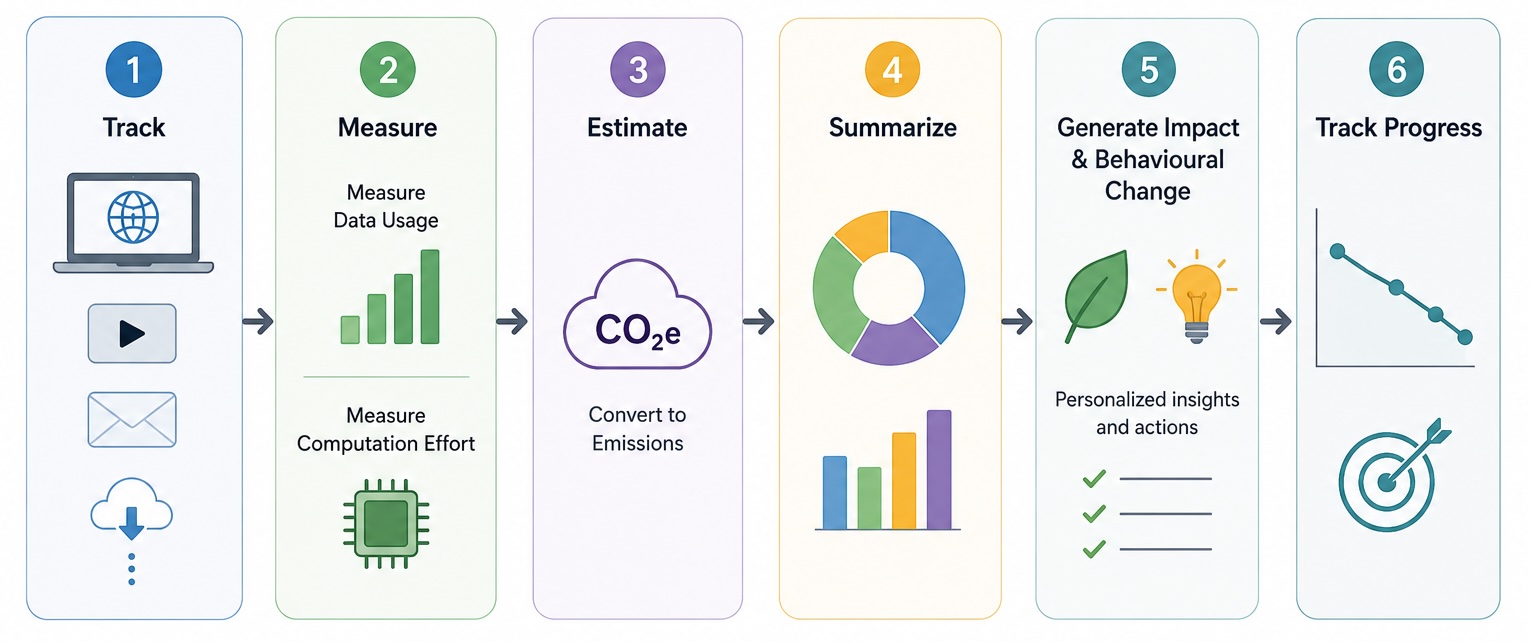
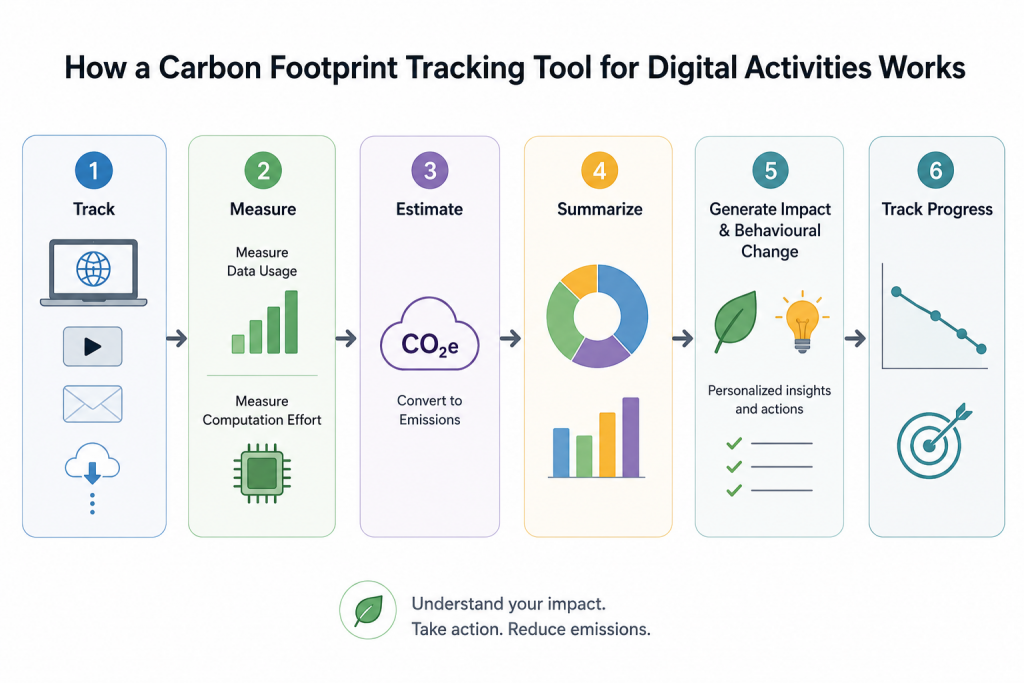
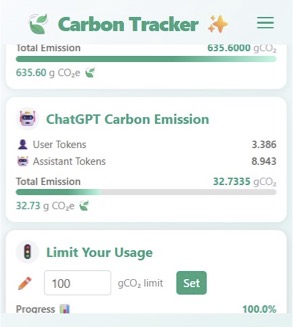
Carbon Tracker monitors digital activities, estimates associated emissions, and presents the information through simple visualizations and analytics. Users can track cumulative emissions, compare browsing and AI-related impacts, set personal targets, and monitor trends over time.
A particularly interesting feature is its support for AI interactions. For ChatGPT conversations, the extension estimates emissions based on the number of input and output tokens processed during the interaction, offering users immediate feedback about the environmental implications of generative AI usage.
To evaluate the tool, we conducted a pilot study involving human participants from different European institutions during a staff training week. Participants completed realistic work-related tasks both before and after being introduced to Carbon Tracker. The results were encouraging.
Participants and quantitative measures reported:
- Positive overall user experience
- Good usability scores
- Increased awareness of the environmental impact of digital activities
- Greater confidence in their ability to adopt sustainable digital behaviors
One of the most interesting findings was a statistically significant increase in self-efficacy—the belief that one’s actions can contribute to more sustainable outcomes.
Participants frequently described the experience as eye-opening. Several were surprised by the emissions associated with AI interactions and appreciated being able to compare the impact of generative AI with that of traditional web browsing.
The environmental footprint of digital technologies is expected to grow significantly over the coming years, particularly due to the increasing use of AI systems. Technical improvements in infrastructure and model efficiency are essential, but they represent only part of the solution. Users also play an important role.
By making environmental information visible at the point of interaction, tools such as Carbon Tracker can help bridge the gap between technology use and sustainability awareness. Small behavioral changes—such as reducing unnecessary AI queries, optimizing usage patterns, or choosing more efficient services—can collectively contribute to lower digital emissions.
Looking Ahead
This work represents an initial step toward integrating sustainability awareness directly into everyday digital experiences.
Future research will investigate long-term behavioral effects, support additional AI platforms and browsers, and explore how eco-feedback mechanisms can be further integrated into common digital tools.
As digital technologies continue to evolve, sustainability should become a visible and understandable aspect of the user experience. Making the environmental cost of our online actions visible may be one of the most effective ways to encourage more responsible digital practices.
After all, we cannot manage what we cannot see.
This work has been published at the ATLAS workshop within the ICWE 2026 conference in Lyon.
You can find a preprint of the paper here:
and the slides of the talk here: